Parent-Involved Therapy

You don't have to sit on the sidelines.
When your child is struggling, it's natural to want to do something to help.
But traditional child therapy can sometimes leave parents wondering what happens in the room - and what they're supposed to do when the same struggles happen at home.
Parent-involved therapy takes a different approach.
Your relationship with your child matters.

Young children develop and learn within relationships.
That doesn't mean you need to be a perfect parent.
It means you don't have to be left out of the process.
What does parent involvement look like?
It depends on your child and your family. Parent involvement might mean:
Regular parent consultations
We talk about what I'm noticing, what you're seeing at home, and how to connect the therapeutic work to everyday life.
Parent + child sessions
We work with your child together so you can learn and practice new ways of responding to your child's emotions and behaviour.
Parent coaching
We focus directly on situations happening at home and work together to understand what's getting in the way and what else you can try.
In-home observation and support
Sometimes seeing your family's routines and interactions in real life gives us information that isn't available in an office.
A combination of approaches
Your family's needs may change over time, so your treatment plan can change too.
This isn't about judging your parenting.
You don't need to have a spotless house (I don't).
You don't need to know exactly what isn't working.
You don't need to have the perfect response ready when your child melts down.
And you don't need to be a different kind of parent.
My role is to come alongside you with curiosity, compassion, and clinical expertise so we can understand what's happening and figure out what might help.
What we're working toward
Not perfect behaviour.
Not perfect parenting.
Not a home where nobody ever gets upset.
Instead, we're working toward things like:
- Better understanding between you and your child
- More confidence responding to difficult moments
- Stronger connection
- Greater emotional awareness
- More manageable everyday routines
- Fewer stuck patterns and power struggles
- Supporting your child's developing skills
- Strategies that make sense for your particular child
- A greater sense that you know what to do when things get hard
The goal is progress that makes sense in your real life.
What if my child needs individual therapy?
They can still have it.
Parent involvement doesn't necessarily mean you are present for every session.
Some children benefit from having their own therapeutic space. Others benefit from more direct parent-child work.
We'll consider your child's age, development, personality, needs, and goals when deciding what will be most helpful.
There is no one-size-fits-all model.
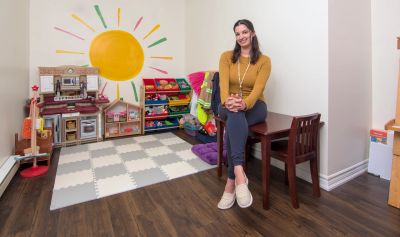
Why work in the home?
Your home is where many of the challenges you're seeking help with actually happen.
In-home therapy can give us the opportunity to understand:
- Your child's everyday routines
- Transitions that are particularly difficult
- Parent-child interactions
- Environmental factors
- What happens before and after challenging moments
- What strategies are realistic for your family
And sometimes, being able to work directly within a real-life situation makes therapy more practical and immediately useful.
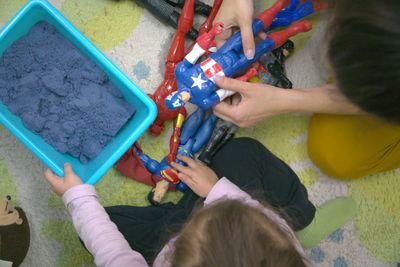

Looking for a more focused option?
Not every family needs or wants an ongoing therapy plan. The Mini Parent-Child Intensive is a one-time option that combines a parent intake, in-home family observation, individualized clinical recommendations, and a feedback session.
It is designed for parents who want a deeper understanding of their child's needs and practical strategies they can begin using at home, without committing to ongoing therapy.
Mini Parent-Child Intensive — $1,000
Learn more about the Mini Parent-Child Intensive